Problem and Context
The existing 2026 E-Shelf had a number of issues; one of the more prominent problems was the busbars that connect the HVIL system. Their awkward bends made assembly difficult.
Additionally, more bends mean a longer busbar before waterjetting and bending. This uses more material and makes the overall system heavier.
Goals
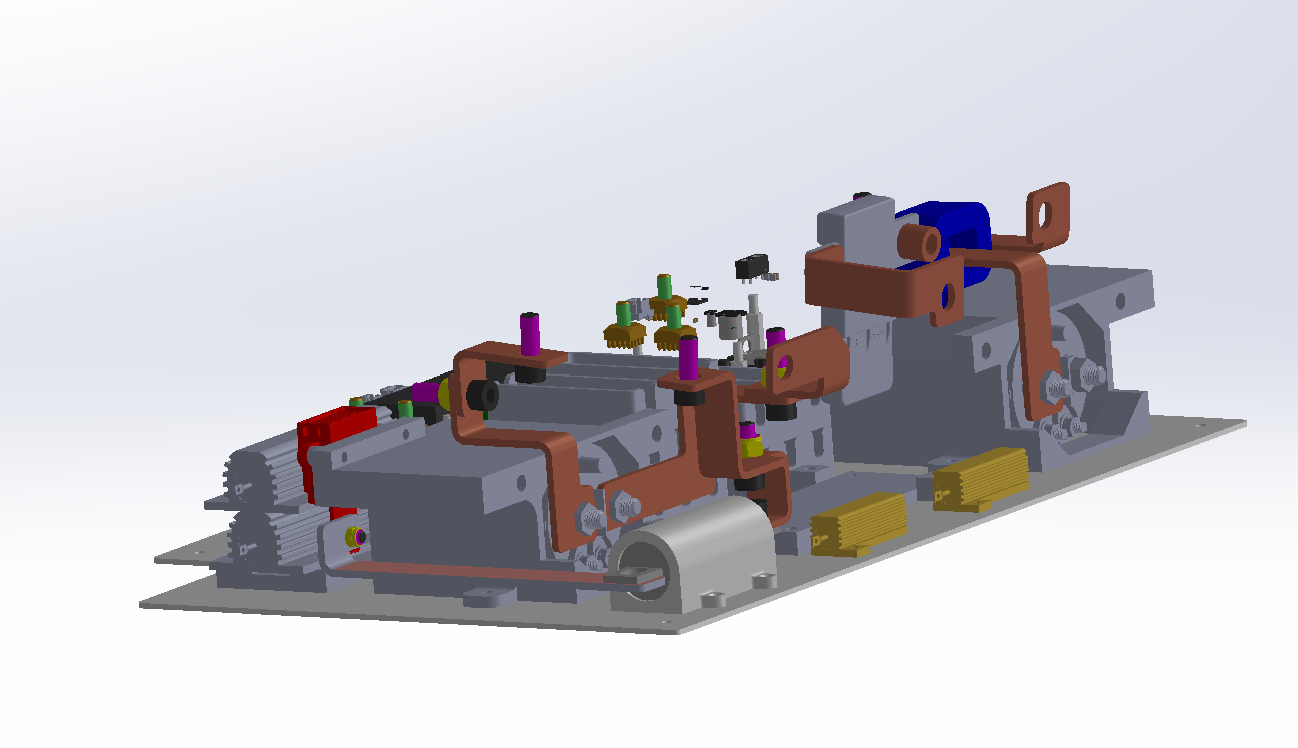
- Reduce the distance the busbars travel.
- Reduce busbar weight.
Proposed Solutions
1. Reduce busbar length
- Keep only critical components: AIRs, IMD, AILED, PCU/DC-DC, and fuses in a linear arrangement to reduce the distance between them.
- Consider the layout used in Northeastern's Hybrid 2026 pack.
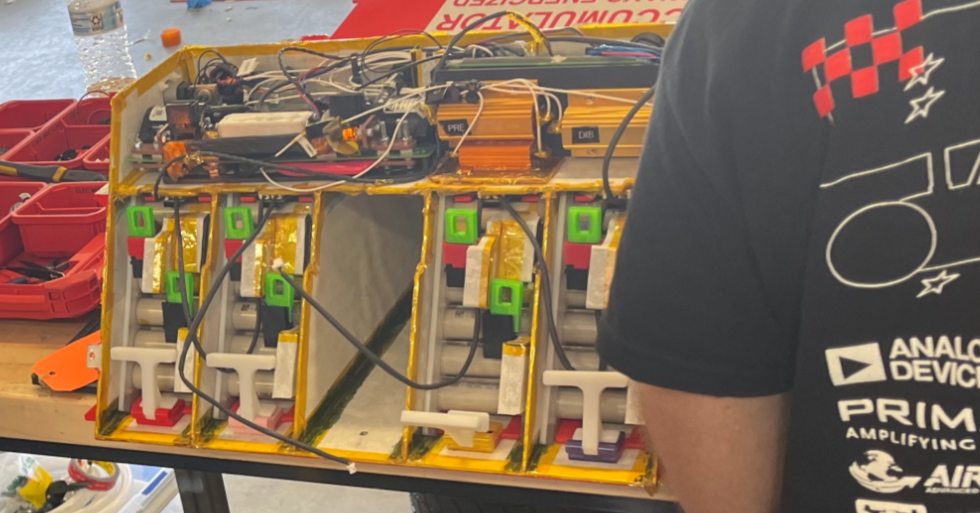
- Consider removing the AIR enclosure, if appropriate.
- Investigate whether smaller contactors could be used. One option is the Altran Magnetics AEV250-M.
2. Reduce busbar weight
Replacing the existing copper busbars with aluminum could significantly reduce weight. Aluminum is approximately 70% lighter than copper.
The main trade-off is conductivity. At its purest, aluminum has approximately 61% of copper's electrical conductivity, so an aluminum busbar requires a larger cross-sectional area to carry the same current.
For aluminum busbars, the required cross-sectional area is approximately 1.6 times that of an equivalent copper busbar.
For the 2026 E-Shelf, we used 1/8 in. (3.18 mm) copper stock. The largest busbar width was 30.12 mm.
Example busbar: 26_TE021_HVD_To_AIR_Busbar_1
| Property | Copper | Aluminum, 1/8 in. stock | 1350 Aluminum | 6101 Aluminum |
|---|---|---|---|---|
| Thickness | 1/8 in. (3.18 mm) | 1/8 in. (3.18 mm) | 1/5 in. (5.08 mm) | 1/5 in. (5.08 mm) |
| Largest width | 30.12 mm | 30.12 × 1.6 = 48.19 mm | 153.25 / 5.08 = 30.12 mm | 30.12 mm |
| Largest cross-sectional area | 3.18 × 30.12 = 95.78 mm² | 95.78 × 1.6 = 153.25 mm² | 153.25 mm² | 153.25 mm² |
| Weight | 67.05 g | — | 33.97 g | 33.84 g |
.png)
This represents an estimated 49% mass saving for this example busbar when using 6101 aluminum instead of copper.
6101 vs. 1350 Aluminum
6101 aluminum is the industry-standard choice for aluminum busbars.
McMaster-Carr does not sell 1/5 in. 6101 aluminum stock. We could mill 1/4 in. stock down to the required thickness. Once the E-Shelf design begins, we can determine the required ampacity and redesign the busbars accordingly.
The thickness of each busbar can be customized to optimize weight, conductivity, and packaging. We should also avoid unnecessary bends. A single stock thickness is not required for every busbar.
Ansys Results for Aluminum Busbar
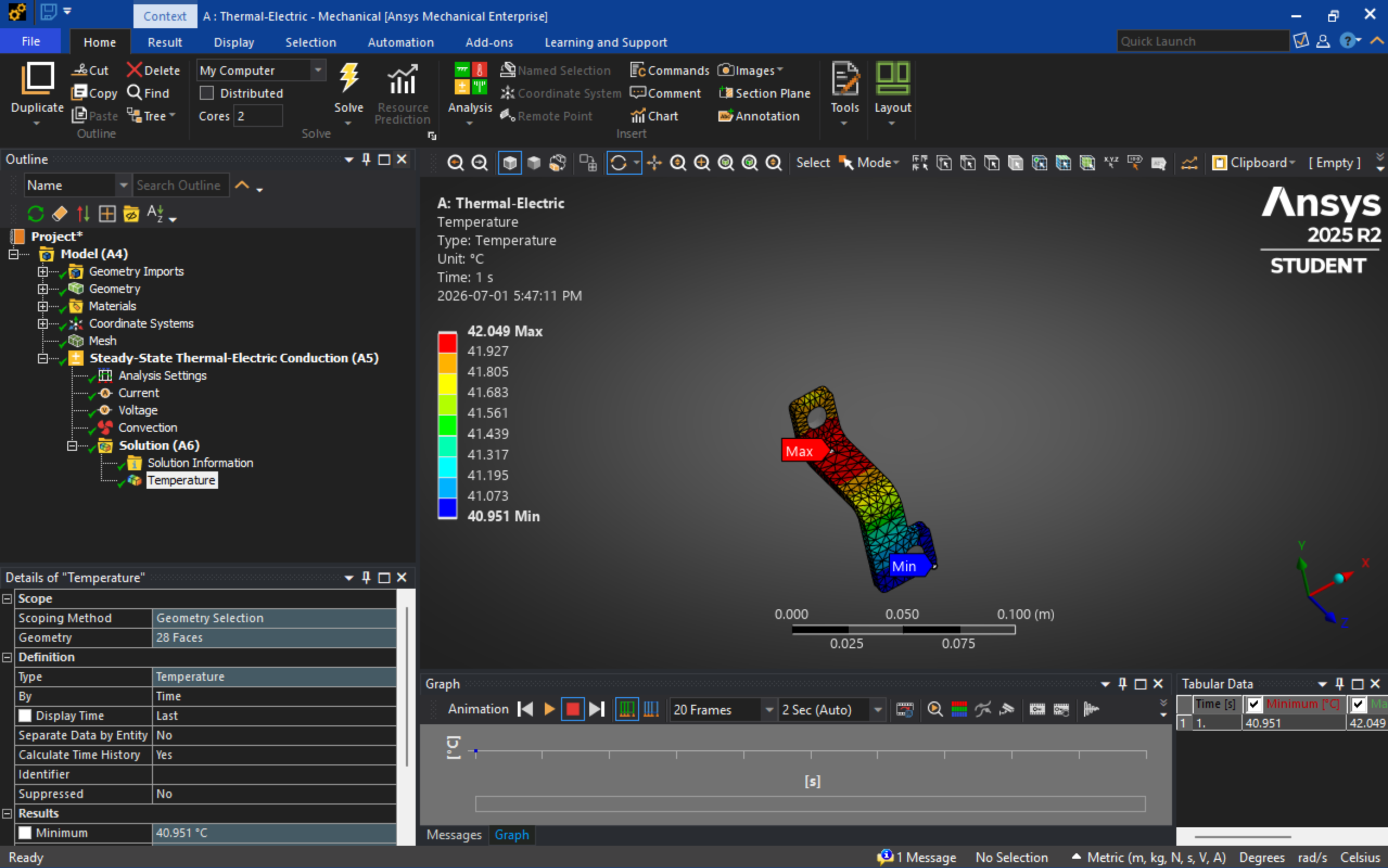
70 A
The simulated steady-state temperature range was 40.951°C to 42.049°C.
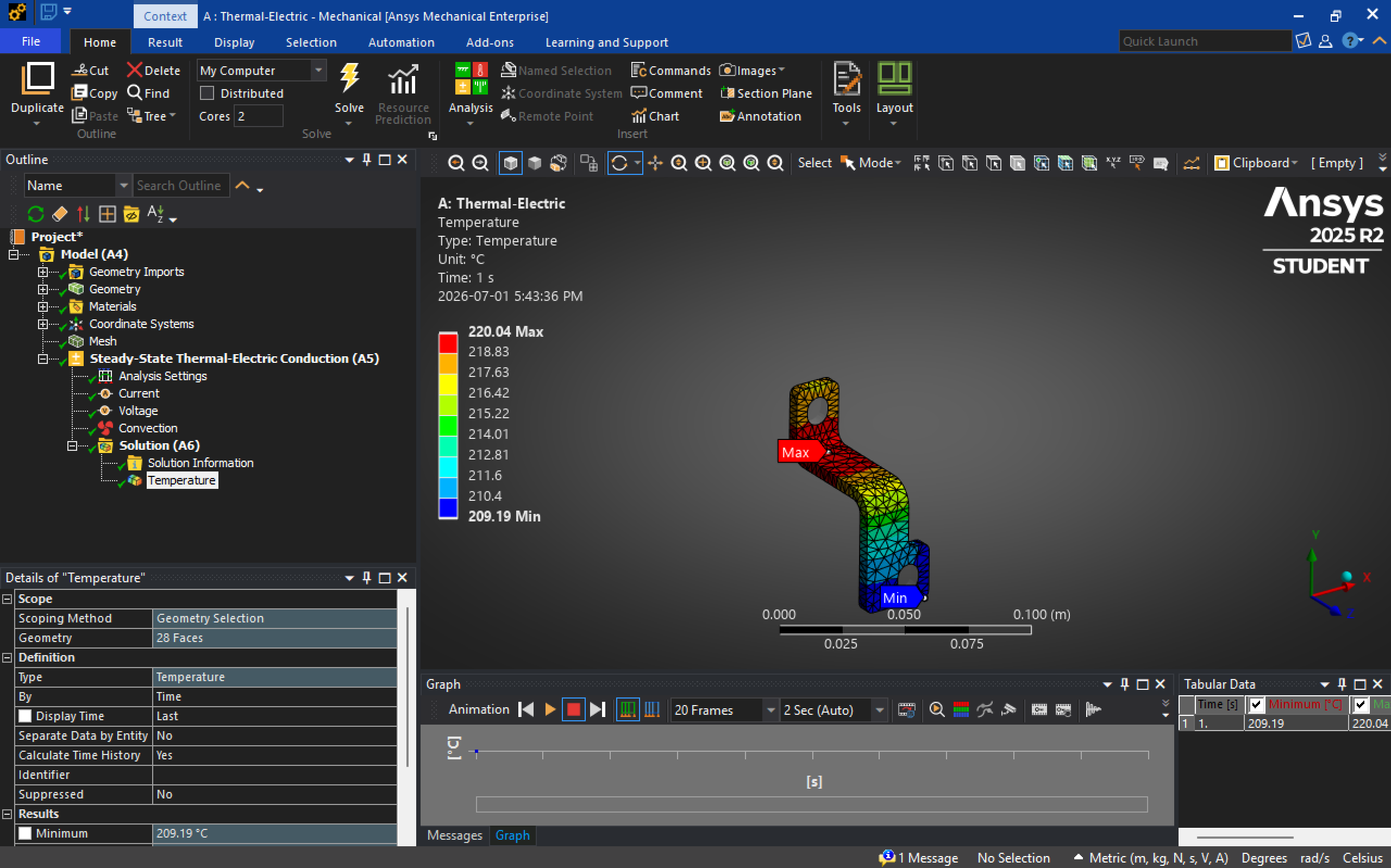
220 A
The simulated steady-state temperature range was 209.19°C to 220.04°C.
The system does not typically operate at 220 A for more than approximately three seconds. Because this simulation is steady-state, it does not accurately represent that short-duration condition.
Recommendation
Use a combination of copper and aluminum busbars. Copper should be retained where its conductivity, compact size, or connection reliability is necessary, while aluminum should be used where weight reduction is the priority and the additional cross-sectional area can be accommodated.